
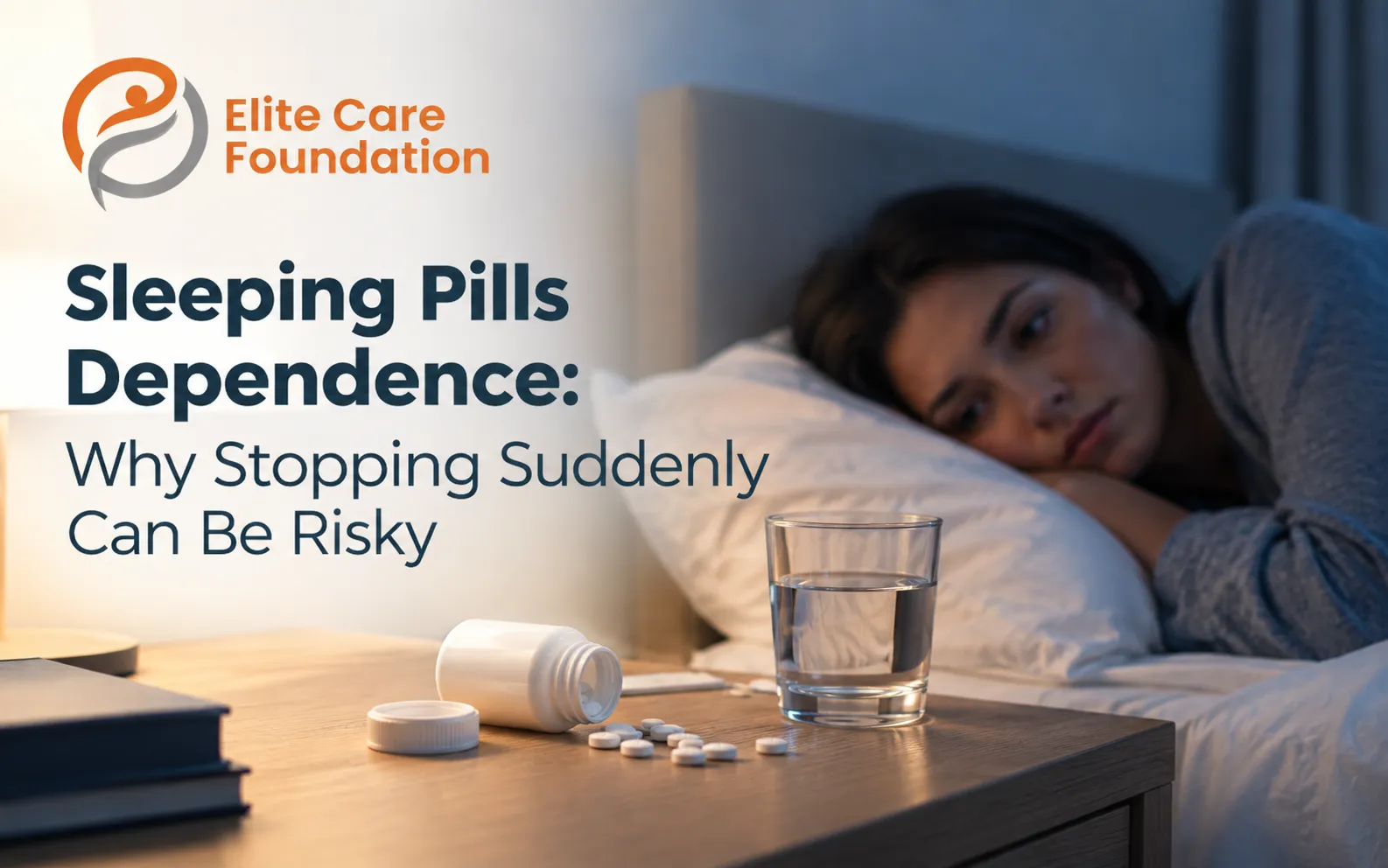
Dependence on sleeping tablets often begins in a way that looks nothing like addiction.
A doctor prescribes medicine during a period of severe insomnia or anxiety. It helps. After a while the person becomes worried about sleeping without it, so the tablet continues. The dose may remain stable for some time or gradually increase. Months later, missing one dose brings anxiety, sleeplessness or physical discomfort that feels worse than the original problem.
This can happen even when the medicine began as a legitimate prescription.
The phrase sleeping pills covers different medicines, and their risks are not identical. Benzodiazepines such as clonazepam, alprazolam or diazepam may sometimes be used in contexts where sleep is a problem, while other medicines such as zolpidem belong to different drug groups. Assessment needs the exact medicine, dose and duration rather than the broad label “sleeping tablet”.
Dependence is not the same as deliberate misuse
A person can become physically dependent without taking tablets to get high.
The nervous system adapts to regular exposure. If the medicine is suddenly reduced or stopped, withdrawal can appear. WHO guidance warns that uncontrolled benzodiazepine withdrawal can be severe and recommends planned, gradual withdrawal rather than abrupt cessation. Severe withdrawal may require specialist care or hospitalisation.
Symptoms can include marked anxiety, rebound insomnia, irritability, poor concentration, tremor and heightened sensitivity. In serious cases, confusion, hallucinations or seizures can occur.
That is why a nasha mukti kendra should not tell every person using sleeping pills to simply throw the tablets away on admission. The treatment team first needs to know exactly what is being taken and whether alcohol, opioids or other sedating medicines are also involved.
Combining sedatives can increase risk. WHO notes that sedatives and sleeping pills can become especially dangerous when used with alcohol, opioids or other depressant drugs because the combined effect can worsen sedation and overdose risk.
The original sleep problem still needs an answer
Stopping a tablet is only half the question if the person still cannot sleep.
Insomnia may be linked with anxiety, depression, chronic pain, irregular working hours, sleep apnoea, restless legs, stimulant use or habits such as spending hours on a phone in bed. If these factors are never assessed, the person may stop one medicine and immediately begin searching for another.
This is one reason sleeping pills addiction treatment needs more depth than detoxification. A medical review can clarify whether dependence has developed and how the medicine should be managed. Psychiatric assessment may identify anxiety or mood symptoms. Sleep-focused behavioural work can help rebuild patterns that do not depend entirely on a tablet.
Families should resist the temptation to create their own taper by cutting tablets at random or copying a schedule found online. The correct pace depends on the drug, dose, duration of use, health conditions and withdrawal response. A plan that is comfortable for one person may be unsafe or intolerable for another.
Look for the behaviour around the medicine
Dependence can show up in ordinary decisions.
The person becomes anxious if fewer tablets remain in the strip. Prescriptions are requested early. Different doctors or pharmacies are approached. Tablets are carried everywhere “just in case”. The dose is taken earlier in the evening, then an extra amount is added when sleep does not come quickly enough.
Memory can become an issue too. Sedative medicines can impair attention and recall, particularly when combined with alcohol or taken in higher amounts than intended. Falls and accidents are a concern, especially in older adults.
Not every long-term user has a substance-use disorder. Some people remain on medicines for reasons that need careful specialist review. The purpose of assessment is not to shame the person for taking a prescribed drug. It is to establish whether benefits still outweigh risks and whether dependence, tolerance or harmful use has developed.
Recovery includes learning to tolerate a bad night
This sounds minor, but it is often central.
Someone who has relied on tablets for months may interpret one poor night of sleep as proof that they cannot manage without them. That fear itself increases arousal and makes sleep harder.
Treatment can work on this cycle. A person learns that sleep naturally varies, that one poor night is uncomfortable rather than catastrophic, and that routines around light, caffeine, exercise, screens and bedtime matter. Where cognitive behavioural therapy for insomnia is available and clinically appropriate, it can be part of a longer-term approach.
Family members may need guidance too. Repeatedly arguing about tablets at midnight rarely improves sleep or trust. It is better to agree on a medical plan and support the person in following it.
Older adults deserve particular care because sedation, poor balance and memory problems can translate into falls, fractures or driving risk. In any age group, repeated dose escalation, lost prescriptions, early refills or combining tablets with alcohol are reasons for prompt medical review rather than another automatic refill.
There is a simple safety message at the centre of all this: dependence on sleeping pills is treatable, but sudden stopping is not a test of willpower.
The safer path is assessment, a medically supervised plan and treatment of the reason the medicine became so hard to live without.
