
482 BNSS is the law that lets you ask the High Court or Sessions Court for bail before the police arrest you in a non-bailable case.
Why Everyone Is Suddenly Searching 482 BNSS
Picture Rohit. He runs a small hardware shop. One evening, his old business partner files a police complaint against him. A friend at the police station whispers, “They may come for you tomorrow.”
What can Rohit do? He does not have to wait for handcuffs. He can ask a court to promise him bail in advance. That promise comes from a short but mighty rule: 482 BNSS.
482 BNSS at a Glance: Quick Stats Table
Before the story gets deeper, here is the whole section on one small shelf. Skim it now, and come back to it later when a friend panics and calls you.
| Detail | Fact |
|---|---|
| Full law name | Bharatiya Nagarik Suraksha Sanhita, 2023 |
| Section number | 482 |
| What it covers | Anticipatory bail (pre-arrest bail) |
| In force from | 1 July 2024 |
| Replaced | Section 438, CrPC 1973 |
| Who can apply | A person who has reason to believe they may be arrested |
| Type of case | Non-bailable offences |
| Where to apply | High Court or Court of Session |
| Special bar | Section 482(4): certain serious sexual offences against young girls (BNS Sections 65 and 70(2)) [Verify against official text] |
| Fixed time limit? | No, not by default (Supreme Court, 2020) |
What Is 482 BNSS in Simple Words?
Section 482 BNSS allows a person who fears arrest for a non-bailable offence to apply for anticipatory bail before arrest. The court may grant protection, reject the application, or provide temporary relief while considering the case. The decision depends on the facts and circumstances.
| Part of the Rule | Plain Meaning |
|---|---|
| Trigger | You have reason to believe you may be arrested |
| Offence type | Non-bailable |
| Who decides | High Court or Court of Session |
| Possible orders | Reject, grant interim protection, or grant final anticipatory bail |
| If arrested later | Police must release you on bail, as the court directed |
| Conditions | Court may attach rules you must follow |
482 BNSS In Hindi: धारा 482 BNSS का आसान मतलब
482 BNSS In Hindi simply means: भारतीय नागरिक सुरक्षा संहिता, 2023 की धारा 482, जो अग्रिम जमानत (anticipatory bail) की व्यवस्था करती है।
अगर आपको लगता है कि पुलिस किसी गैर-जमानती अपराध में आपको गिरफ्तार कर सकती है, तो आप गिरफ्तारी से पहले उच्च न्यायालय या सत्र न्यायालय में जमानत की अर्ज़ी लगा सकते हैं। अदालत चाहे तो गिरफ्तारी की स्थिति में आपको जमानत पर छोड़ने का आदेश दे सकती है।
| Hindi Word | English Meaning |
|---|---|
| अग्रिम जमानत | Anticipatory (pre-arrest) bail |
| गैर-जमानती अपराध | Non-bailable offence |
| गिरफ्तारी | Arrest |
| सत्र न्यायालय | Sessions Court |
| उच्च न्यायालय | High Court |
| जमानत आवेदन | Bail application |
| अंतरिम संरक्षण | Interim protection |
| शर्तें | Conditions |
482 BNSS In CrPC: Where Did the Old Section Go?
Here is a common mix-up. People type 482 BNSS In CrPC hoping to find the section inside the old code. But BNSS is a replacement law, not a chapter of CrPC. The old twin of this rule is Section 438 of the CrPC.
There is a second trap. Old CrPC also had a Section 482, which gave High Courts “inherent powers” (the power to cancel unfair cases). That one now lives at Section 528 BNSS. So “482 CrPC” and “482 BNSS” are two different things with the same number.
| Topic | Old CrPC Section | New BNSS Section |
|---|---|---|
| Anticipatory bail | 438 | 482 |
| Bail in bailable offences | 436 | 478 |
| Bail in non-bailable offences | 437 | 480 |
| Special bail powers of High Court and Sessions Court | 439 | 483 |
| Bail for long-time undertrials | 436A | 479 |
| High Court inherent powers | 482 | 528 |
Section 482 BNSS and the 482 BNSS Act: Who Can Apply?
Both phrases, Section 482 BNSS and 482 BNSS Act, point to the same rule. Strictly speaking, the “Act” is the BNSS as a whole, and 482 is one section inside it.
You can apply if you can show a real reason to fear arrest. A vague worry (“someone might dislike me”) is not enough. A police notice, an FIR naming you, or a clear complaint against you gives your fear a solid base.
| Situation | Can You Apply? | Why |
|---|---|---|
| FIR registered, you are named | Yes | Clear reason to fear arrest |
| Complaint filed, police calling you again and again | Usually yes | Real threat of arrest |
| Offence is bailable | Not needed | You already get bail as a right |
| Already arrested in the same case | No | The remedy is regular bail (Section 483 BNSS) |
| Already in custody in a different case | Possible in some cases | Courts have allowed it, depending on facts [Verify] |
| Only a vague fear, no complaint | Unlikely | Courts want a real reason |
What Changed From 438 CrPC to 482 BNSS?
The Parliament did not throw the old rule away. It kept the heart and trimmed some parts. The biggest talking point is the missing checklist. Old Section 438 listed things a judge should weigh, such as how serious the accusation is, the accused’s past record, the chance of running away, and whether the case was filed just to humiliate the person.
| Feature | 438 CrPC | 482 BNSS |
|---|---|---|
| Checklist of factors in the text | Yes | Removed |
| Notice to Public Prosecutor with interim order | Required (438(1A)) | Omitted, per legal commentary [Verify] |
| Applicant’s presence at final hearing | Mandatory in some cases (438(1B)) | Omitted, per legal commentary [Verify] |
| Conditions on grant | Allowed | Allowed (including not leaving India without permission) |
| Exceptions for serious sexual offences | Section 438(4) | Section 482(4), wording uses “and” instead of “or” |
| Effective date | 1974 onward | 1 July 2024 |
482 BNSS Anticipatory Bail: Step-by-Step Process
Now the practical part. Here is how 482 BNSS Anticipatory Bail moves from panic to paper to a courtroom. Keep your calm and your documents close.
| Step | What Happens | Tip |
|---|---|---|
| 1 | Collect the FIR copy, complaint, or police notice | Note the sections of law mentioned |
| 2 | Meet a criminal lawyer | Share every fact, even awkward ones |
| 3 | Draft the application | Use clear dates and simple language |
| 4 | File before the Sessions Court or High Court | Keep extra copies |
| 5 | Court may issue notice to the prosecutor | Be ready for a hearing date |
| 6 | Interim protection may be considered | Not guaranteed |
| 7 | Final hearing and order | Court accepts or rejects |
| 8 | After grant, follow conditions | Join the investigation when called |
Which Court Should You Approach?
The law lets you go to either the Court of Session or the High Court. Many people begin with the Sessions Court because it is closer and quicker to reach. If it says no, the High Court is the next door. Some people go straight to the High Court. Local court practice can differ, so ask your lawyer.
| Court | When It Makes Sense | Things to Remember |
|---|---|---|
| Court of Session | First choice for most people | Easier access, usually quicker listing |
| High Court | After rejection or for complex cases | Higher fees, longer lists in some states |
| Supreme Court | Appeal after High Court rejection | Reached through a special appeal |
482 BNSS Bail Application Format: A Simple Structure
Every court has its own flavour, so treat this as a skeleton, not a copy-paste job. A 482 BNSS Bail Application Format tells the judge who you are, what the case is, why you fear arrest and what you want. A good application is short, factual and polite.
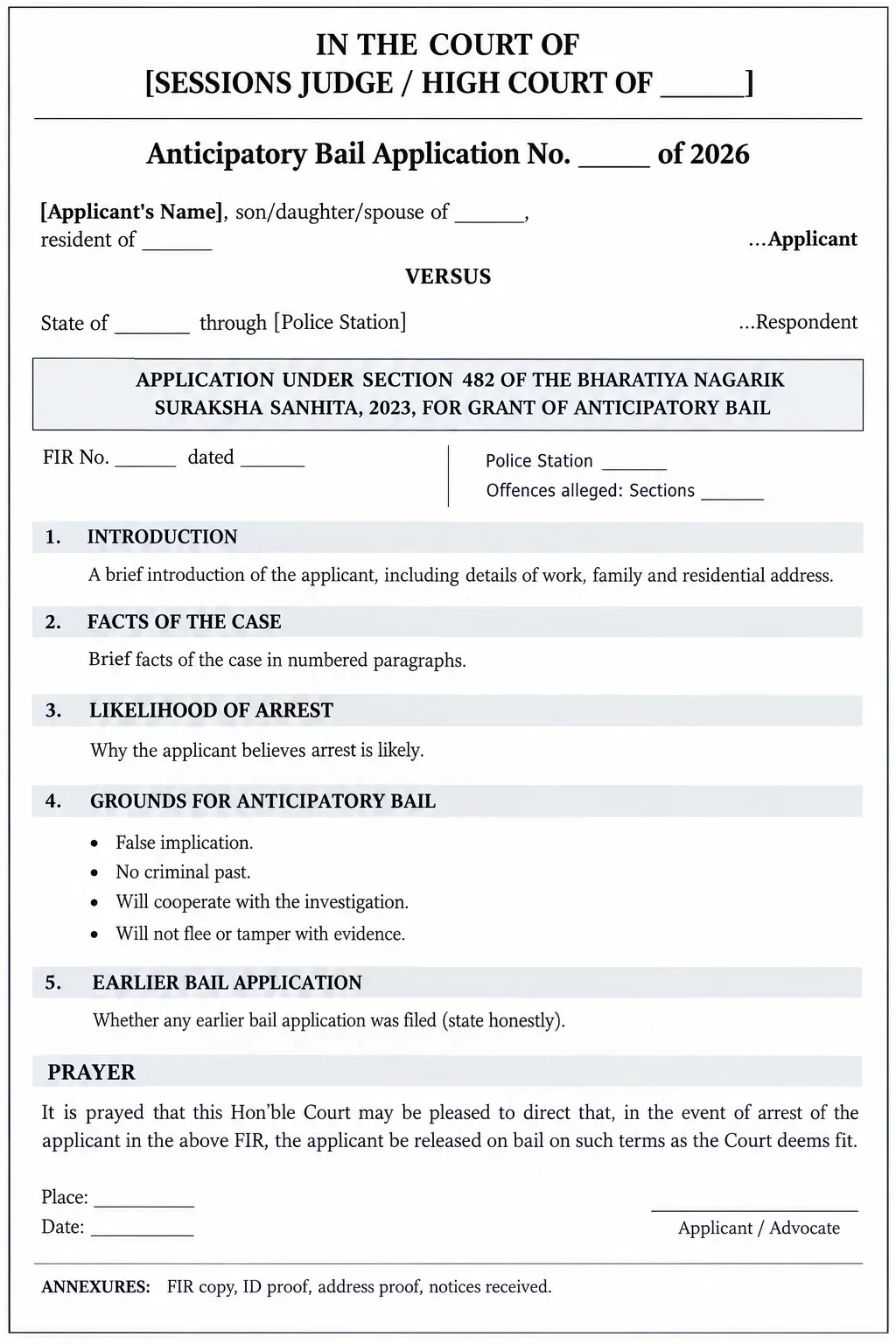
Here is what each part does.
| Part of Application | Purpose | Common Slip |
|---|---|---|
| Court heading and case number | Shows the right court | Wrong court name |
| Parties | Identifies you and the State | Spelling mistakes |
| FIR details | Links the case to your fear | Missing FIR number or date |
| Facts | Tells your side of the story | Long, emotional paragraphs |
| Grounds | Gives reasons for bail | Copying generic grounds |
| Prayer | States what you want | Forgetting to mention the section |
| Annexures | Proves your claims | Missing documents |
What Conditions Can the Court Attach?
Anticipatory bail is not a free pass. Courts often attach rules. Break them, and the protection can be cancelled.
| Typical Condition | What It Means for You |
|---|---|
| Join the investigation when called | Show up when the police ask |
| No threats or pressure on witnesses | Stay far away from people linked to the case |
| No leaving India without permission | Surrender or keep passport details ready |
| Provide a personal bond and surety | Someone vouches that you will follow the rules |
| Any other fair condition | Judge’s choice based on the facts |
When 482 BNSS Will Not Help You
Even a strong umbrella fails in some storms. Knowing the limits saves you time and money.
| Situation | What Happens |
|---|---|
| Offences covered by Section 482(4) (certain sexual offences against young girls) | Anticipatory bail is barred |
| You are already arrested in that case | Apply for regular bail instead |
| Special laws with their own bail rules (for example, the SC/ST Act and some terrorism or money-laundering laws) | Extra conditions or bars may apply |
| State-specific restrictions on old Section 438 | Courts are still deciding whether they survive under 482 BNSS; the Uttarakhand High Court referred this question to a larger bench [Verify latest status] |
| Court finds the accusation serious and your conduct doubtful | Application can be rejected |
Legal Case Studies: Court Decisions Made Simple
Judges have shaped how 482 BNSS works, mostly by interpreting the older Section 438. These stories matter because the new section keeps the same spirit.
Case Study 1: Gurbaksh Singh Sibbia v. State of Punjab (1980)
| Element | What to Explain |
|---|---|
| Case Name | Gurbaksh Singh Sibbia and others v. State of Punjab |
| Background | A group of persons, including a state minister, feared arrest in a corruption-related matter and asked for anticipatory bail |
| Legal Question | Should a judge use fixed formulas or rigid conditions before granting pre-arrest bail? |
| Court’s Decision | A five-judge bench of the Supreme Court said no rigid formula; each case needs its own thought |
| Legal Principle | Courts have wide discretion; personal liberty matters; there is no automatic time limit |
| Why It Matters | It is the base of all anticipatory bail law, and the same thinking guides Section 482 BNSS today |
Case Study 2: Sushila Aggarwal v. State (NCT of Delhi) (2020)
| Element | What to Explain |
|---|---|
| Case Name | Sushila Aggarwal and others v. State (NCT of Delhi) |
| Background | Courts disagreed whether anticipatory bail should end after a fixed period or when the accused is summoned |
| Legal Question | Does protection expire automatically at some stage? |
| Court’s Decision | A five-judge bench said there is no default time limit; protection can continue until the trial ends unless the court gives special reasons |
| Legal Principle | Courts may add conditions, but they should not cut short the protection by habit |
| Why It Matters | It saves applicants from running back to court again and again |
Legal Myth vs Fact Table
Court corridors are full of half-truths. Here is a quick reality check.
| Myth | Fact |
|---|---|
| 482 BNSS is only for rich people | Any person who fears arrest can apply |
| Anticipatory bail means the case disappears | The case continues; only arrest is restricted |
| You can apply for any offence | There are exceptions, such as Section 482(4) |
| Bail ends after the chargesheet | Not automatically; see the 2020 Supreme Court ruling |
| You need not cooperate after getting bail | You must join the investigation when called |
| One High Court’s view is the law everywhere | Other High Courts may see things differently until the Supreme Court decides [Verify] |
| 482 CrPC and 482 BNSS are the same | They are different; the old 482 CrPC is now Section 528 BNSS [Verify] |
| A lawyer is optional | Technically possible without one, but risky and not smart |
Conclusion
Section 482 BNSS provides anticipatory bail protection against arrest for non-bailable offences, subject to legal exceptions. Effective from 1 July 2024, it replaced Section 438 CrPC, allowing Sessions Courts and High Courts to consider applications based on individual circumstances. Courts may impose conditions, and protection has no automatic fixed time limit. Consult a qualified lawyer to prepare an accurate application and check the latest legal provisions.
Read More
Frequently Asked Questions
1. Is 482 BNSS the same as 438 CrPC?
Yes, both deal with anticipatory bail, but some provisions differ.
2. Is there a time limit on anticipatory bail under Section 482 BNSS?
No fixed limit applies automatically; courts may impose conditions.
3. Can I apply before an FIR is registered?
Possibly, if there is a genuine apprehension of arrest. Consult a lawyer.
4. What if the court rejects my application?
You may approach a higher court, but arrest protection is not automatic.
5. Do I have to appear in court myself?
Your lawyer can represent you, but the court may require your presence.
6. Is 482 CrPC the same as 482 BNSS?
No. Section 482 CrPC concerned inherent powers; Section 528 BNSS now covers them.
7. Where can I read the 482 BNSS Act text and a sample bail format?
Check the official BNSS text and consult a lawyer to prepare your application.
