
How many of us actually know what Article 21 of the Indian Constitution says beyond “right to life”? If you’re nodding your head right now, don’t worry. You’re not alone. Most Indians know Article 21 exists the same way they know they have a spleen — they’re aware of it, but couldn’t tell you exactly what it does.
Well, today, we’re fixing that. Buckle up, because we’re about to take a deep, fun, fact-checked dive into one of the most important — and honestly, most underrated — articles of our Constitution. Whether you’ve Googled “Article 21 kya hai” at midnight, wondered about right to privacy Article 21, or you just want to sound really smart at your next family dinner, this article is for you.
Quick Stats Table: Understanding Article 21 of Indian Constitution
| Aspect | Details |
|---|---|
| Article Number | Article 21 |
| Constitutional Chapter | Part III – Fundamental Rights |
| Year Introduced | 1950 (Indian Constitution Adoption) |
| Basic Text | “No person shall be deprived of his life or personal liberty except according to procedure established by law” |
| Type of Right | Fundamental Right |
| Applicability | All persons in Indian territory |
| Scope | Life, Liberty, Privacy, Health, Dignity, Freedom |
| Key Landmark Case | Menaka Gandhi v. Union of India (1978) |
| Right to Privacy Recognition | Justice K.S. Puttaswamy v. Union of India (2017) |
| Related Fundamental Rights | Articles 14, 15, 16, 19 |
| Number of Sub-rights Derived | 20+ recognized by courts |
| Supreme Court Judgments | 1000+ cases decided under Article 21 |
| Geographic Coverage | All of India |
| Applicability to Citizens | Yes, All persons including non-citizens |
What Is Article 21 of the Indian Constitution? The Simple Version
Let’s start from the very beginning (a very good place to start, as someone once sang).
Article 21 of the Indian Constitution reads:
“No person shall be deprived of his life or personal liberty except according to procedure established by law.”
That’s it. One sentence. 23 words. And yet, our Supreme Court has stretched those 23 words into a glorious umbrella that covers everything from your right to breathe clean air to your right to watch a movie in peace. Honestly, the framers of our Constitution were probably not expecting that level of creative interpretation — but here we are.
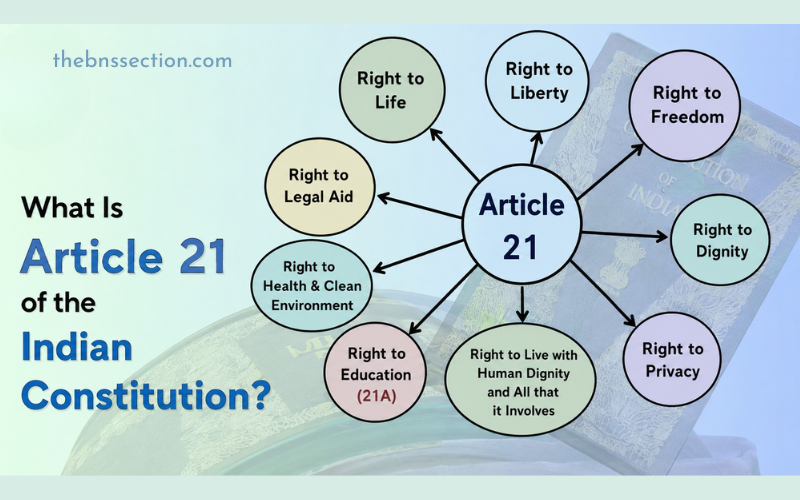
In its essence, what is Article 21 about? It guarantees two core things:
- Right to Life — not just biological existence, but a life worth living
- Right to Personal Liberty — freedom from arbitrary arrest, detention, or physical restraint
The beauty of Article 21 of Indian Constitution in Hindi (अनुच्छेद 21) is that it applies to every person on Indian soil — not just citizens. So yes, if you’re a foreign national visiting India, you’re also protected. How’s that for hospitality?
The Evolution: How Article 21 Expanded Over Time
Here’s something that fascinates legal scholars: What is Article 21 has continuously transformed based on what society needs and what courts deem necessary for human dignity. This isn’t static law – it’s breathing, living, adapting.
The Early Years: 1950-1970s
When India adopted its Constitution in 1950, Article 21 of the Indian Constitution was interpreted quite narrowly. Courts basically understood it as: “Don’t execute people without a fair trial. Don’t lock people up without following proper procedures.” Pretty straightforward, right?
But then came a seismic shift.
The Menaka Gandhi Case: The Game-Changer (1978)
The Supreme Court’s decision in Menaka Gandhi v. Union of India was the moment everything changed. Menaka Gandhi (daughter of the former PM Indira Gandhi) wanted to travel abroad, and the government said “no” without giving proper reasons. She challenged this under Article 21.
The Supreme Court’s response was revolutionary: “Personal liberty doesn’t just mean physical liberty. It includes the right to travel, the right to choose where you live, and the right to basic human dignity.” Suddenly, Article 21 of Indian Constitution became this expansive umbrella covering numerous rights we take for granted.
The Modern Era: Expanding Horizons (1990s-Present)
Fast forward to recent decades, and Article 21 of the Indian Constitution in Hindi and English versions have been interpreted to include:
- Right to Privacy (2017) – In a landmark judgment, the Supreme Court declared privacy a fundamental right under Article 21
- Right to Die with Dignity – Including passive euthanasia rights
- Right to Health – Including access to clean water, unpolluted air, and nutritious food
- Right to Education – Though also covered separately, it’s protected under Article 21
- Freedom of Conscience – Including your right to make personal decisions about your body
- Marital Autonomy – Your right to marry whom you choose
- Sexual Orientation Rights – Protecting LGBTQ+ individuals’ fundamental freedoms
It’s been quite a journey from simple “don’t execute people arbitrarily” to “you have a right to live with dignity in all aspects of human existence.”
The Story Behind Article 21: From Boring to Brilliant
Here’s something they don’t teach you in school — Article 21 used to be pretty boring.
In 1950, the Supreme Court interpreted Article 21 very narrowly. In the infamous A.K. Gopalan v. State of Madras case (1950), the court said that “procedure established by law” simply meant any procedure the law prescribed. So if Parliament passed a law that said you could be thrown in jail for singing off-key, that would technically be fine. (Okay, slight exaggeration. But only slight.)
Then came 1978, and with it — the game-changer.
Maneka Gandhi v. Union of India turned everything around. The Supreme Court held that the “procedure established by law” must be fair, just, and reasonable. It cannot be arbitrary, fanciful, or oppressive. This single judgment transformed Article 21 from a narrow procedural guarantee into a living, breathing fundamental right that has continued to expand ever since.
Expert Insight — Constitutional Law Perspective: “Article 21 is the most litigated and most evolved provision in the Indian Constitution. Post-Maneka Gandhi, the courts have read into Article 21 a whole range of rights that collectively constitute what a dignified human life should look like in a democratic society.” — As articulated by leading constitutional scholars in academic commentary on Indian fundamental rights jurisprudence.
The 7 Powerful Rights Hidden Inside Article 21
Now here’s where it gets really good. The Supreme Court of India has, over decades of judgments, read the following rights into Article 21 of the Constitution. Each one of these has been confirmed through actual case law. No guesswork, no clickbait.
1. Right to Life with Dignity
This is the big one. In Francis Coralie Mullin v. Administrator, Union Territory of Delhi (1981), the Supreme Court held that the right to life includes the right to live with basic human dignity. That means access to adequate nutrition, clothing, shelter, and facilities for reading, writing, and expressing oneself. You’re not just entitled to exist — you’re entitled to live properly.
2. Right to Privacy
Ah yes, right to privacy Article 21 — the one that went viral in 2017.
In Justice K.S. Puttaswamy v. Union of India (2017), a nine-judge bench of the Supreme Court unanimously held that privacy is a fundamental right under Article 21. This landmark judgment has massive implications — from Aadhaar data to your WhatsApp chats. The court declared that every individual has the right to control their personal information and the right to be left alone.
So technically, that annoying neighbor who reads your postcards? They’re violating your fundamental rights. (Please don’t sue your neighbors on our advice, though.)
3. Right to Health
In Paschim Banga Khet Mazdoor Samity v. State of West Bengal (1996), the Supreme Court held that the government has an obligation to provide adequate medical facilities. Right to life Article 21 includes the right to health and medical care.
This is especially significant given that India spends approximately 1.84% of its GDP on public health (as per Union Budget 2023–24) — a statistic that makes this right even more important to enforce.
4. Right to Speedy Trial
Languishing in jail for years without a trial? That violates Article 21. In Hussainara Khatoon v. Home Secretary, State of Bihar (1979), the Supreme Court held that an accused person has the fundamental right to a speedy trial. Today, India has over 43 million pending cases in courts — which makes this right both crucial and, unfortunately, heavily tested.
5. Right to Livelihood
In Olga Tellis v. Bombay Municipal Corporation (1985), the Supreme Court ruled that the right to livelihood is part of the right to life Article 21. Because let’s be honest — if you can’t earn a living, can you really “live”? Evicting pavement dwellers without alternative arrangements, the court said, amounts to depriving them of life itself.
6. Right to Education (Before Article 21A)
Before Article 21A was inserted (which we’ll talk about shortly), the Supreme Court in Mohini Jain v. State of Karnataka (1992) and Unni Krishnan v. State of A.P. (1993) held that the right to education flows from Article 21. Education is essential to lead a dignified life, and therefore, it became a part of the right to life.
7. Right to a Clean Environment
In Subhash Kumar v. State of Bihar (1991), the Supreme Court held that the right to live in a pollution-free environment is part of Article 21. So yes, when factories dump toxic waste into rivers, they’re not just breaking environmental laws — they’re violating your fundamental right to life.
Article 21 in Hindi: अनुच्छेद 21 क्या है?
For our readers wondering about Article 21 in Hindi or Article 21 Mein Kya Hai, here’s the simplest explanation:
अनुच्छेद 21 (Article 21 Hindi) भारतीय संविधान के भाग III में आता है, जो मौलिक अधिकारों से संबंधित है। इसमें कहा गया है:
“किसी व्यक्ति को उसके प्राण या दैहिक स्वतंत्रता से विधि द्वारा स्थापित प्रक्रिया के अनुसार ही वंचित किया जाएगा, अन्यथा नहीं।”
Article 21 Kya Hai — संक्षेप में कहें तो: यह आपके जीने का, सम्मान से जीने का, और स्वतंत्रता के साथ जीने का अधिकार है। यह अधिकार न केवल नागरिकों को बल्कि भारत की धरती पर रहने वाले हर व्यक्ति को प्राप्त है।
Article 21 and the Right to Vote: Clearing the Confusion
A common search query is right to vote Article 21 — and this needs some clarification.
The right to vote in India is not a fundamental right under Article 21. It is a constitutional right under Article 326, which provides for adult suffrage. The Supreme Court in Jyoti Basu v. Debi Ghosal (1982) held that the right to vote is a statutory right, not a fundamental right.
However, the right to cast a negative vote (NOTA — None of the Above) was recognized by the Supreme Court in People’s Union for Civil Liberties v. Union of India (2013), and the court linked the right to meaningful participation in democracy to the broader spirit of Article 21 and the right to dignity.
So while voting itself isn’t Article 21, the right to participate meaningfully in democracy has been connected to the dignity aspect of life guaranteed under Article 21 of the Indian Constitution.
Article 21 vs. Article 19: The Dynamic Duo
People often confuse Articles 19 and 21. Here’s a quick breakdown:
| Feature | Article 19 | Article 21 |
|---|---|---|
| Rights Covered | 6 Freedoms (speech, movement, profession, etc.) | Life and Personal Liberty |
| Applies to | Only Citizens | All Persons |
| Nature | Freedom Rights | Protective Rights |
| Suspension | Can be suspended during Armed Rebellion Emergency | Cannot be suspended even during Emergency |
| Interplay | Often read together with Article 21 | Reinforces Article 19 in many cases |
Post-Maneka Gandhi, these two articles are read together and in harmony. A law that violates Article 19 may also violate Article 21, and vice versa.
Conclusion: Article 21 — More Than Just a Law
So here’s the thing about Article 21 of the Indian Constitution — it’s not just a constitutional provision. It’s a promise. A promise that every person who walks on Indian soil deserves to live, not just breathe; to be free, not just physically unchained; to have dignity, not just rights on paper.
From the right to privacy to the right to a clean environment, from access to healthcare to the right to education under Article 21A, this one article has been stretched, expanded, and strengthened by decades of judicial wisdom.
Article 21 is the Constitution’s way of telling the State: you cannot take a person’s life, liberty, or dignity unless the law demands it AND that law itself is fair and just. In a world where both are frequently tested, knowing your rights under Article 21 of Indian Constitution is not just empowering — it’s essential.
Read More:
- THE BNS SECTION
- 144 BNSS in Hindi
- 302 धारा क्या है
- 281 BNS
- 352 BNS in Hindi
- 354 IPC in Hindi
- 351(3) BNS in Hindi
- 115(2) BNS in Hindi
- 333 BNS in Hindi
- 74 BNS in Hindi
Frequently Asked Questions
Q1. What is Article 21 of the Indian Constitution?
Article 21 guarantees the Right to Life and Personal Liberty to all persons. It states that no person shall be deprived of life or personal liberty except according to a procedure established by law that is fair, just, and not arbitrary.
Q2. Does Article 21 apply only to Indian citizens?
No! Unlike many other fundamental rights, Article 21 applies to all persons — including foreign nationals — on Indian soil.
Q3. What is Article 21A?
Article 21A was added by the 86th Constitutional Amendment in 2002. It provides for free and compulsory education for children aged 6 to 14 years, which was operationalized through the RTE Act, 2009.
Q4. Is the Right to Privacy covered under Article 21?
Yes. The Supreme Court in the landmark Justice K.S. Puttaswamy v. Union of India (2017) held that the right to privacy is a fundamental right under Article 21 of the Indian Constitution.
Q5. Can Article 21 be suspended during a National Emergency?
No. Thanks to the 44th Constitutional Amendment (1978), Articles 20 and 21 cannot be suspended even during a national emergency declared under Article 352.
Q6. What is Article 21 in Hindi?
Article 21 in Hindi (अनुच्छेद 21) में कहा गया है कि किसी भी व्यक्ति को विधि द्वारा स्थापित प्रक्रिया के बिना उसके जीवन या व्यक्तिगत स्वतंत्रता से वंचित नहीं किया जाएगा।
Q7. Is the right to vote part of Article 21?
No. The right to vote is not a fundamental right under Article 21 — it is a constitutional/statutory right under Article 326 and relevant election laws.
Q8. What rights does Article 21 protect beyond life?
Courts have expanded Article 21 to include the right to health, right to education (before 21A), right to livelihood, right to a speedy trial, right to privacy, right to dignity, right to clean environment, and right to sleep, among others.
Q9. What is the most important judgment related to Article 21?
The Maneka Gandhi v. Union of India (1978) case is widely considered the turning point for Article 21, expanding its scope from a narrow procedural guarantee to a broad protection of life and liberty in the fullest sense.
Q10. Can a private entity violate Article 21?
Traditionally, Article 21 operates against State action. However, courts have increasingly recognized that the State must also ensure protection of fundamental rights against certain private actions, especially in cases involving privatized essential services.
Explore more blogs at: Iconichonors.com
